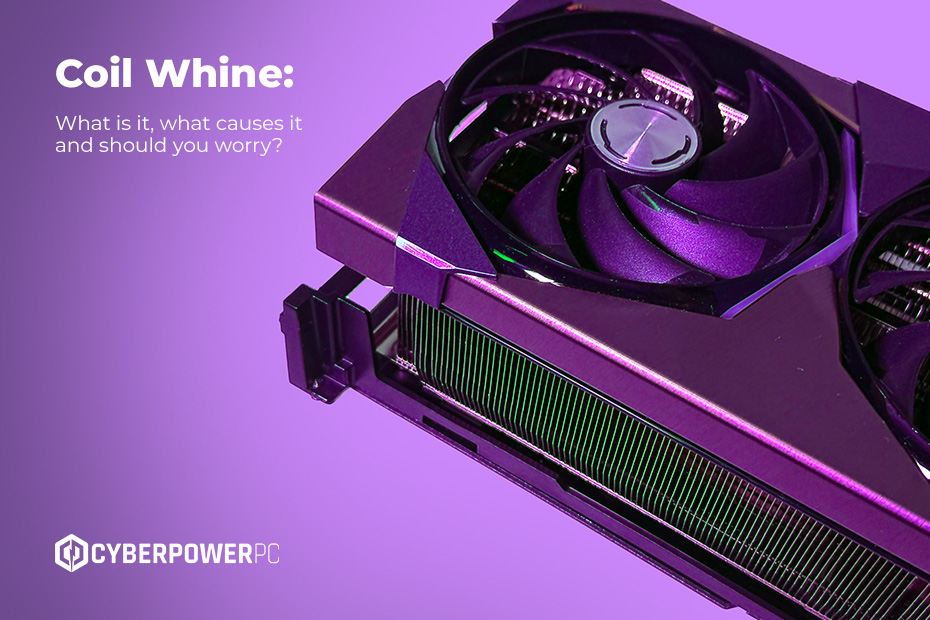
If you’ve ever bought a gaming PC and noticed a strange, high-pitched noise coming from inside the case, you’re not alone. One of the most common (and most misunderstood) issues gamers encounter is coil whine. It’s the sort of sound that can drive you mad once you notice it — a faint squeal, buzz, or chirping noise that seems to appear under load, in menus, or even when scrolling a webpage.
Coil whine is incredibly common, especially among PC gamers who’ve just installed a new graphics card or power supply. The good news is that coil whine is usually harmless. The bad news is that it can be annoying, unpredictable, and difficult to completely eliminate.
In this guide, we’ll break down everything you need to know about coil whine in PCs and laptops, including coil whine in GPUs, CPUs, and PSUs. We’ll explain what it sounds like, what causes it, whether it’s dangerous, and what you can realistically do to reduce or fix it. We’ll cover:
What Is Coil Whine?
At its core, coil whine is an electrical noise. It occurs when electrical current passes through components that contain coils or inductors, causing them to vibrate. These vibrations can produce an audible sound, typically a high-frequency squeal, buzz, or whistling noise.
The simplest explanation is this: it’s the sound of electrical components physically vibrating due to power flow. It is not a software issue, not a fan issue, and not usually a sign that something is broken.
Coil whine most commonly comes from the GPU, but it can also originate from the power supply, motherboard, or CPU power delivery.
What Does Coil Whine Sound Like?
One of the most frustrating aspects of coil whine is that it doesn’t sound the same for everyone. It can be described as a high-pitched buzzing, squealing, chirping, or whining noise, and it often changes pitch depending on what the PC is doing. You might notice it when your GPU is rendering hundreds of frames per second in a menu, when launching a game, or even when scrolling through a webpage.
Unlike fan noise, coil whine doesn’t sound like airflow or a steady hum. It’s sharper, more electronic, and often intermittent. Some people barely notice it unless the room is silent, while others find it immediately irritating.
How to Tell the Difference Between Coil Whine and Other Noises
Distinguishing coil whine noise from fan noise or electrical issues is important, especially when troubleshooting. Fan noise usually changes with temperature and airflow. Coil whine changes with FPS (frames per second) and power load. If the pitch changes when you alt-tab, scroll, or enter a game menu, it’s almost certainly coil whine.
Is Coil Whine Bad or Dangerous?
The reassuring answer is: no, coil whine is not harmful. Coil whine does not damage your GPU, PSU, CPU, or any other component. It doesn’t reduce lifespan, affect stability, or indicate imminent failure. From a technical standpoint, coil whine is purely an acoustic issue.
That said, just because it isn’t dangerous doesn’t mean it’s irrelevant. For gamers who care about quiet systems, immersion, or streaming setups with sensitive microphones, coil whine can be a genuine problem. It’s annoying, distracting, and once you notice it, it’s very hard to ignore.
What Causes Coil Whine?
The main cause of coil whine is electrical current passing through inductors at high frequencies. These components are designed to handle power efficiently, but they’re not designed to be completely silent. When current fluctuates rapidly, the magnetic fields around the coils cause tiny physical movements, which produce sound.
Several factors can increase the likelihood of coil whine. High frame rates are a big one. When a GPU is rendering hundreds or thousands of frames per second, power draw changes extremely quickly, increasing vibration. Power quality also matters. A noisy or low-quality PSU can exacerbate coil whine in other components, even if it isn’t whining itself.
Manufacturing tolerances play a role too. Two identical graphics cards can behave differently, with one exhibiting coil whine and the other being nearly silent. This is why coil whine is often considered a “silicon lottery” issue, it’s largely down to chance.
GPU Coil Whine: The Most Common Culprit
When people talk about coil whine, they’re usually referring to GPU coil whine. Modern graphics cards are extremely powerful and draw large, rapidly fluctuating amounts of power. This makes them the perfect environment for coil whine to occur.
In GPU coil whine, the sound is produced by inductors on the graphics card vibrating as power flows through them. These vibrations are more noticeable when the GPU is under light but high-FPS loads, such as game menus, loading screens, or uncapped frame rate scenarios.
Ironically, coil whine often appears when a GPU is performing exceptionally well. If your graphics card is pushing out 500 FPS in a menu, it’s working incredibly efficiently and that rapid power cycling can make coils sing. This is why people often notice coil whine GPU noise in older or less demanding games, or even outside of games entirely.
PSU Coil Whine and CPU Coil Whine
Although GPUs are the most common source, PSU coil whine is also fairly common. Power supplies contain multiple inductors and transformers, and under certain loads they can produce audible noise. This is especially noticeable when system power demand changes rapidly, such as during gaming or stress testing.
CPU coil whine is less common, but it can occur around the CPU power delivery area on the motherboard. This is sometimes mistaken for fan noise or GPU whine, but the pitch and behaviour are usually similar.
Identifying the exact source can be tricky. Coil whine often resonates through the case, making it sound like it’s coming from somewhere else entirely, so don’t rule it out straight away.
Coil Whine When Scrolling or in Menus
One of the strangest coil whine scenarios is when it happens during non-gaming tasks. People often report coil whine when scrolling web pages, moving windows, or hovering over UI elements. This can be especially common on high-refresh-rate monitors.
What’s happening here is that the GPU is rapidly redrawing frames, even during basic desktop tasks. When frame rates spike without any frame rate limiting, power draw fluctuates rapidly, and coil whine can appear. This is why enabling frame rate caps or adaptive sync can sometimes reduce or eliminate the noise entirely.
PC Coil Whine vs Laptop Coil Whine
While desktop PCs get most of the attention, laptop coil whine is also very common. In fact, gaming laptops can be even more prone to it due to their compact design and tightly packed components.
In a desktop PC, coil whine might come from the GPU, PSU, or motherboard, and the case can help dampen the sound. In a laptop, everything is crammed into a thin chassis with very little acoustic insulation. This can make coil whine more noticeable, especially when the laptop is plugged in and running at full performance.
You may hear a high-pitched noise during charging, gaming, or heavy workloads. Unfortunately, laptop coil whine is usually harder to reduce because there’s limited room for component changes or airflow adjustments.
How to Stop or Reduce Coil Whine
If you’re wondering how to stop coil whine, it’s important to set expectations. Coil whine can often be reduced, but it can’t always be completely eliminated.
One of the most effective solutions is limiting frame rates. Enabling V-Sync, G-Sync, or FreeSync, or manually capping FPS using in-game settings or driver software, can dramatically reduce coil whine by smoothing power delivery. For more FPS tips, check out our guide to optimising frame rate settings.
Undervolting the GPU is another popular approach. By reducing voltage while maintaining performance, you can lower power fluctuations and reduce vibration. Many modern GPUs respond extremely well to undervolting, and it can also lower temperatures and power consumption.
Using a high-quality power supply can help as well. While a PSU won’t magically fix GPU coil whine, clean and stable power delivery can reduce the severity. Poor-quality or ageing PSUs are more likely to worsen coil whine across the system.
How to Fix Coil Whine in Laptops
Laptop users have fewer options, but there are still things worth trying. Reducing maximum performance modes, limiting FPS in games, and ensuring the laptop isn’t running at unnecessarily high refresh rates can all help. Some users also report improvements after BIOS updates, which can adjust power delivery behaviour.
Physically fixing laptop coil whine is rarely practical, and whether or not you can return a laptop with coil whine varies between manufacturers. Because coil whine isn’t considered a fault, many brands won’t replace a laptop unless the noise is extreme.
FAQs
Is Coil Whine a Reason to Return Hardware?
This is a tricky area. Coil whine is not a defect, and most manufacturers don’t treat it as one. However, if coil whine is extremely loud, intrusive, or clearly abnormal, some retailers may accept a return or exchange.
From experience, mild coil whine is considered normal behaviour in high-performance gaming hardware. Severe coil whine that’s audible across a room, even under normal loads, is less common and more likely to be considered unacceptable.
Should You Avoid Certain GPUs or Brands?
Coil whine is not brand-specific. Every manufacturer experiences it across different models and generations. Higher-end GPUs are often more prone to it simply because they push more power at higher frequencies.
Buying from a reputable builder or retailer helps, as systems are properly tested and paired with suitable power supplies. While no one can guarantee zero coil whine, good component matching reduces the likelihood of severe cases. All our pre-built and custom gaming PCs are put together by our team of experts, and our PC Finder tool makes it simple and convenient to find exactly what components you need.
Does Coil Whine Get Better Over Time?
Interestingly, coil whine can sometimes lessen after a few weeks of use. As components “bed in”, vibrations can reduce slightly. This isn’t guaranteed, but many gamers report that coil whine becomes less noticeable over time, or that they simply stop noticing it once they know it’s harmless.
Coil whine is one of those PC gaming quirks that sits somewhere between harmless and irritating. It doesn’t damage your hardware, it doesn’t reduce performance, and it doesn’t mean something is wrong with your PC. But it can be distracting, especially in quiet rooms or high-FPS scenarios.
Understanding what coil whine is, what causes it, and how to reduce it puts you in control. With sensible frame rate limits, good power delivery, and realistic expectations, coil whine is something most gamers can live with, or barely notice at all.For enthusiasts chasing maximum performance, it’s often the trade-off for powerful hardware. And in the grand scheme of PC gaming problems, it’s one of the better ones to have. For more gaming tips, PC advice, and guides to PC parts, be sure to check out the rest of our blog.